
What “Woman-Owned” Actually Means to Us
Spend enough time in advertising, and you start to notice something. The industry is full of women. They’re writing the briefs, running the accounts, directing the shoots, presenting the work. Then you look at who owns the agencies, and the picture changes fast.
Nearly thirty years in business and nine with me at the helm, the “woman-owned” designation shows up on our credentials and in our RFP responses. But what it means to us is a lot more specific than a certification.
The numbers tell you something.
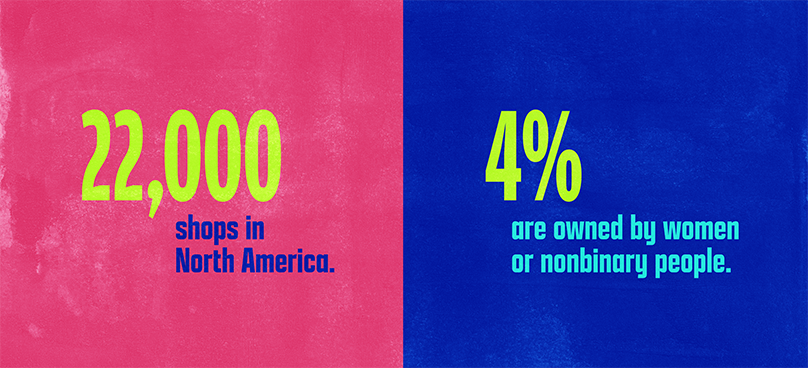
Women own roughly 40% of all businesses in the U.S., unless you’re talking about advertising agencies. Of the 22,000 shops in North America, less than 4% are owned by women or nonbinary people, according to the best available data from the 4A’s. Read that again. An industry that is predominantly female by headcount — women now make up 55% of the advertising workforce — is almost entirely male-owned at the top. (Source: Ads of Brands, AdWeek)
It’s a pattern that shows up across corporate America. Women held 29% of C-suite positions in 2024, up from just 17% in 2015, but the “broken rung” persists: for every 100 men promoted to manager, only 81 women receive that same first promotion. The Annual LeanIn.org and McKinsey Women in the Workplace Study, now in its eleventh year, has found women underrepresented at every level of the corporate pipeline each year it has been conducted. Every year. Eleven in a row. (Source: Women In the Workplace)
Globally, women held 28.3% of board seats at large- and mid-cap companies as of October 2025, according to the MSCI Women on Boards and Beyond annual report, a figure that moves in tenths of a percentage point annually. At that pace, parity is a long way off. (Source: MSCI)
The organizations doing something about this, including Leanin.org and 50/50 Women on Boards, are worth knowing about if you care about this work. We do.
So what does it mean for us in practice?
Our executive leadership team is two women: me and our COO, Tracy Hitchcock. We have paid parental leave, fully paid insurance from day one, and a culture where it’s okay to be a human being with a life outside this building. We invest in our people, and they stay and grow.
It also means we think carefully about the work we put out into the world. The messages we create reach real people. We’ve built campaigns around mental health, workforce equity, and community connection. Our work matters and our team rallies around creative that makes an impact.
And here’s something the industry doesn’t talk about enough: women are the primary target audience for an enormous number of brands. Consumer research consistently shows that women drive the majority of purchasing decisions. The perspective gap is real, and it shows up in the work. At Stoltz, that perspective is built in.
What it doesn’t mean.
It doesn’t mean we lead every pitch with it, or that the certification does the work for us. It’s a descriptor. The agency’s personality is built through 30 years of showing up, doing the work, and making it worth caring about.
But context matters. When less than 4% of agencies are woman-owned, and when only half of companies surveyed in 2025 said women’s career advancement was a high priority, being here and still going matters. We’re not going to be quiet about that. (Source: Women In the Workplace)