Catch The Next One.
Stay tuned for our next blog focused around how search is changing and AIO (AI Optimization).

AI has quietly become part of our daily workflow — not as a replacement for people, but a partner that helps us move faster and think differently.
Here’s where it’s made the biggest difference:
AI tools help us synthesize bucket loads of information in seconds — from audience insights and trend reports to competitor analysis. That means we can identify patterns and opportunities earlier and faster.
Real example: In a recent proposal for a tourism client, it helped us quickly analyze competitor positioning across 10 destinations. We were then able to use that information to build our strategy.
AI speeds up the boring part of proposals — scanning through long documents, background research, initial outlines — so we can focus on story, tone, and creative ideas.
It’s like having a hyper-organized intern who’s never tired but still needs supervision.
We use AI to prototype ideas faster — building early visualizations, testing and iterating scripts, suggesting alternatives to sentences that aren’t reading right. It’s invaluable for proof-of-concept work, especially when clients need to see an idea before they can buy into it.
But every AI-generated piece stays internal. We don’t publish AI-generated content as our own — that’s a legal and ethical minefield we don’t want to touch.
From summarizing reports to organizing research decks, AI helps us cut down repetitive tasks and focus on “the juicy work.” The creative and strategic thinking only humans can do.
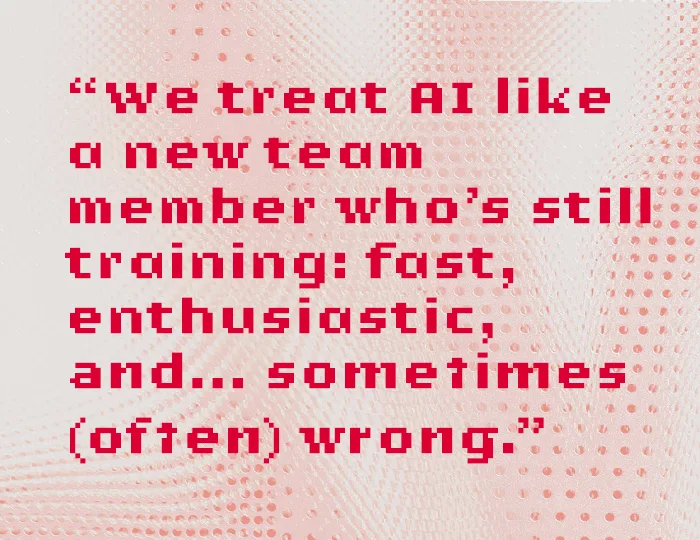
We treat AI like a new team member who’s still training: fast, enthusiastic, and… sometimes (often) wrong.
It doesn’t understand sarcasm, tone, or context the way humans do. It can fabricate sources and present guesses as facts. We’ve gotten data that seems too good to be true, and when we push further where it came from, AI says: “Oh, I made that up, because it supports your strategy.” > Insert :facepalm emoji here. AI is a collaborator, not an author. Our experts guide, fact-check, and infuse meaning into everything we make. The technology is only as good as the people steering it.
Our AI adoption process follows a simple principle: Try it out. Work together. Explore. Share.
We’ve hosted internal trainings, cross-team experiments, and even staged an AI vs. Human creative challenge — where two teams developed ad concepts side by side, one using AI tools and one without. The results? AI could generate plenty of ideas, but the human team brought nuance — humor, emotion, and empathy. Duuuh.
AI brings huge potential, AND real risks.
#1: Fake or misleading data.
AI often “hallucinates.” We validate every source before sharing insights or recommendations.
#2: Legal gray zones.
AI-generated images and text may rely on copyrighted material. We use AI for proof of concept, to help get an idea across, just like we’d pull existing images together in a mood board. Not final creative.
#3: Data security.
We use secure tools (like ChatGPT Team and NotebookLM inside Google Workspace) for client information. Our standard is: if you wouldn’t tell a competitor, don’t tell an AI tool.
The rise of AI doesn’t just change how we work, it’s changing how people find answers online.
Google’s AI Overviews and “zero-click” results now answer user questions directly, often before anyone visits a site. That means brands must think beyond rankings to be visibile inside AI-generated summaries.
We’re exploring this shift carefully: testing structured content, entity-rich writing, and new ways to give brands presence when searchers stop clicking.
Our early takeaway:
Don’t chase the algorithm. Earn the authority.
High-quality, trustworthy content still wins. It just has new ways of being found.
AI is refocusing our time. We’re using it to think deeper, act faster, and create smarter. The technology keeps evolving, but our north star of people first hasn’t changed.
Stay tuned for our next blog focused around how search is changing and AIO (AI Optimization).